
Brand Positioning Research: Turning Your Brand’s Customer Data Into a Defensible Claim
Discover how brand positioning research uses customer data, competitive insights, and market evidence to build a unique, credible, and defensible brand claim.
October 12, 2026

KEY TAKEAWAYS
Positioning has always been about standing out from competitors. But the number of competitors, and the places buyers compare them, has multiplied. There are now lower barriers to entry and people buy online. Most categories are now crowded with brands making the same promises: faster, simpler, more affordable, more personal.
When everyone says the same thing, buyers stop listening.
At the same time, the first place many people encounter a brand is through a search results page or an AI-generated answer. Those answers depend heavily on what others say about you.
AI Branding: Why AI Is Making Brands Sound the Same
Chris Fulmer from The Brand Auditors appears on the DoneMaker podcast to explain how to use AI without losing your unique brand identity.
An analysis by AI search platform AirOps found that 85% of brand mentions in AI search come from third-party sites, not brands' own domains. A brand positioning strategy is more technical than it used to be. A claim only carries weight online if it is reinforced by the reviews, articles and conversations search engines and AI tools draw from.
That is why brand positioning research has become so vital. Real customer data can point a company to a unique claim it can use to differentiate itself that is both true and hard for competitors to copy.
What brand positioning research is meant to produce
Brand positioning describes how a company wants buyers to see its brand compared with the alternatives they could choose instead.
A review of the positioning literature by Karolina Janiszewska and Andrea Insch published in 2012 traces the idea back to Al Ries and Jack Trout, who framed it in 1981 as a contest for space in the customer's mind.
A brand's position was a competitive concept from the start. What has changed is how many brands are in that contest, and how many places buyers now go to settle it.
The definitions vary. However, they all point to the same deliverable. There is one specific idea that a defined group of buyers associates with you rather than with an alternative. Research does not exist to confirm that a claim sounds impressive. It establishes which promise your buyers already recognize as true, and which ones they would reject.
Why a positioning strategy collapses without research
Janiszewska and Insch, writing in the Journal of International Studies (Vol. 5, No. 1, 2012), argue that a position only works if it is significant to the target group, on a functional and an emotional level. Meeting that condition, they note, requires detailed analysis and research into the target group. Their paper focuses on place brands such as cities and regions. But the principle carries over to any brand. Remove those aspects, and positioning becomes an internal conversation about adjectives, settled by whoever holds the most authority in the room.
Practitioner guidance points the same way. A guest post on the Qlarity Access blog describes market research and positioning strategy as complementary processes that should be performed together.
The article also observes that companies often treat research and positioning strategy as sequential. But sequencing changes the questions you ask. When the two run together, each round of evidence narrows the claim until a choice becomes obvious.
Claim territories vs. target audience perception
A University of Twente study of brand positioning strategies found that most existing brands are positioned on a small set of territories: values, target audience, emotional benefits, prototype brand and price.
Understanding which territory a claim occupies tells you what evidence will be needed to uphold it.
| Territory | What the claim usually says | What it requires to survive |
|---|---|---|
| Values | We stand for this | Behavior customers can observe |
| Target audience | We are built for this group | Proof the segment is distinct and reachable |
| Emotional benefit | Choosing us should feel like this | Language customers use about outcomes |
| Prototype brand | We are the reference point | Heritage, recognition, awards, testimonials |
| Price | You get more for what you pay | A cost structure that holds |
Because the list is short, crowded categories often have several competitors in the same territory. Naming your brand's territory also tells you who you are really up against.
A common failure is claiming one territory while funding another. For example, a company that positions on prototype status but competes on price will lose the positioning argument before the product goes to market.
The customer data that supports a claim
The volume of data is not the constraint, weight is. A hundred survey responses that repeat a generic sentiment will not inform a positioning decision the way three specific, unsolicited customer statements can.
Evidence from inside the business
Internal assets include the brand's heritage, industry recognition, awards, customer testimonials and any scientific research behind your product or service. These are the materials that make a chosen claim credible. They are also the easiest to overestimate, because leadership teams tend to value them more highly than buyers do.
Janiszewska and Insch make a similar point. An audit of brand assets should be checked against research into how the target group actually perceives them, then ranked by significance and credibility.
Evidence from market research
In addition to competitive benchmarking, research into target groups should capture behavior and motivations, not just stated preferences. That means looking at what buyers actually did. Which alternatives did they compare, what triggered the search, which objections appeared late in the process, and which words did they use when describing the problem?
Tone is part of this evidence too. In a 2017 Sprout Social survey of 1,003 consumers, 86% said they wanted brands to be honest on social media and 83% wanted them to be friendly. Yet only 43% wanted trendy and 33% wanted snarky.
The figures are dated, but the lesson is still relevant. Tone is part of positioning, not a finishing layer applied at the end.
Evidence that lives off-site
This layer is easy to overlook. However, it is the one search engines and AI tools lean on.
Reviews, comparison pages, forum threads and industry articles describe your brand in words you did not choose. AirOps reports that 48% of AI search citations come from community platforms, which makes those conversations a direct input to how buyers first meet you.
Treat that material as research data. Collect how third parties describe you and your competitors, run the questions your buyers ask through search engines and AI assistants, and see which brands appear and in what terms. The gap between the target audience's brand perception language and your intended claim shows how far the position has to travel.
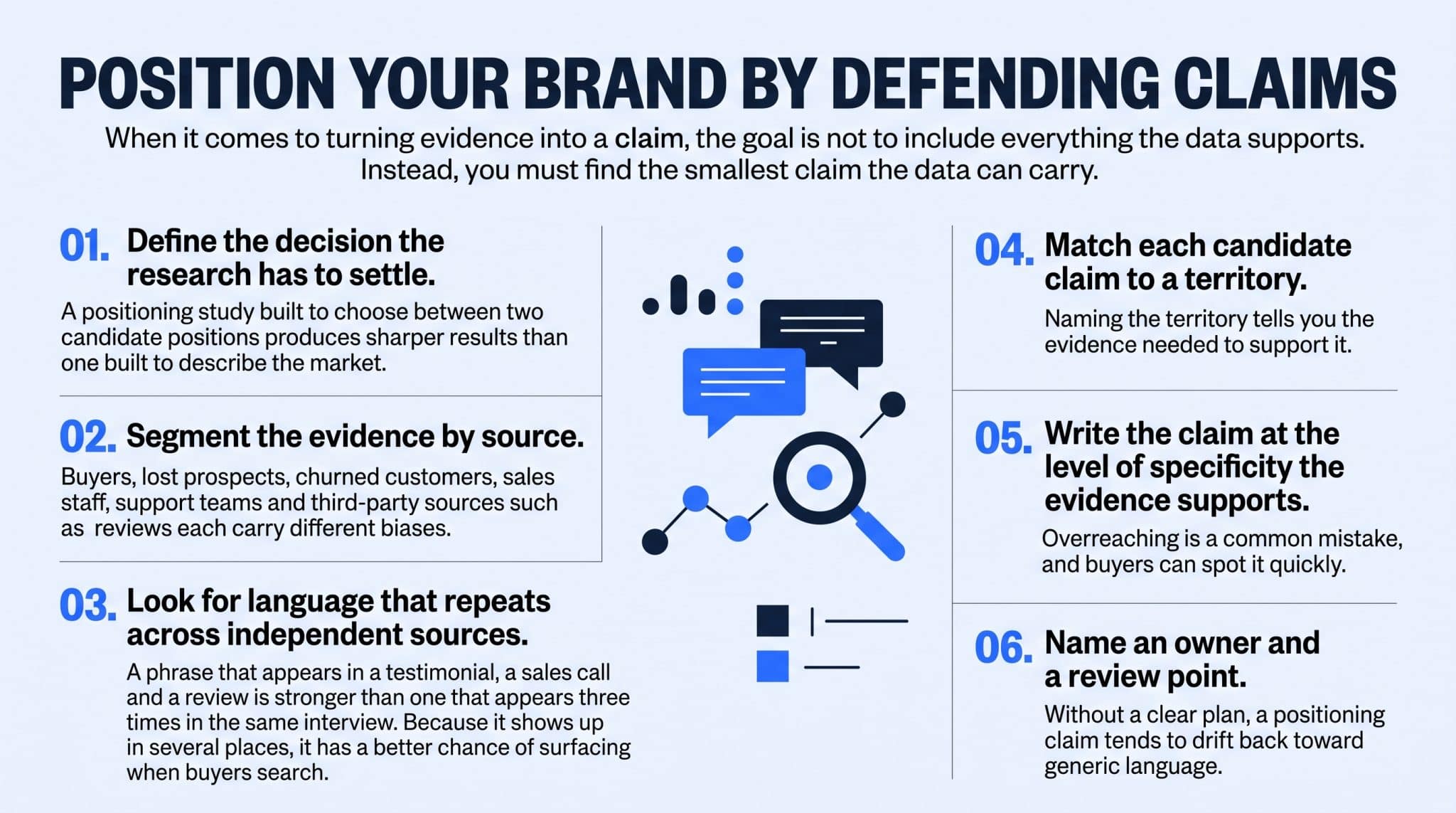
Position your brand by defending claims
When it comes to turning evidence into a claim, the goal is not to include everything the data supports. Instead, you must find the smallest claim the data can carry.
-
Define the decision the research has to settle. A positioning study built to choose between two candidate positions produces sharper results than one built to describe the market.
-
Segment the evidence by source. Buyers, lost prospects, churned customers, sales staff, support teams and third-party sources such as reviews each carry different biases.
-
Look for language that repeats across independent sources. A phrase that appears in a testimonial, a sales call and a review is stronger than one that appears three times in the same interview. Because it shows up in several places, it has a better chance of surfacing when buyers search.
-
Match each candidate claim to a territory. Naming the territory tells you the evidence needed to support it.
-
Write the claim at the level of specificity the evidence supports. Overreaching is a common mistake, and buyers can spot it quickly.
-
Name an owner and a review point. Without a clear plan, a positioning claim tends to drift back toward generic language.
Pressure-testing claims before you commit
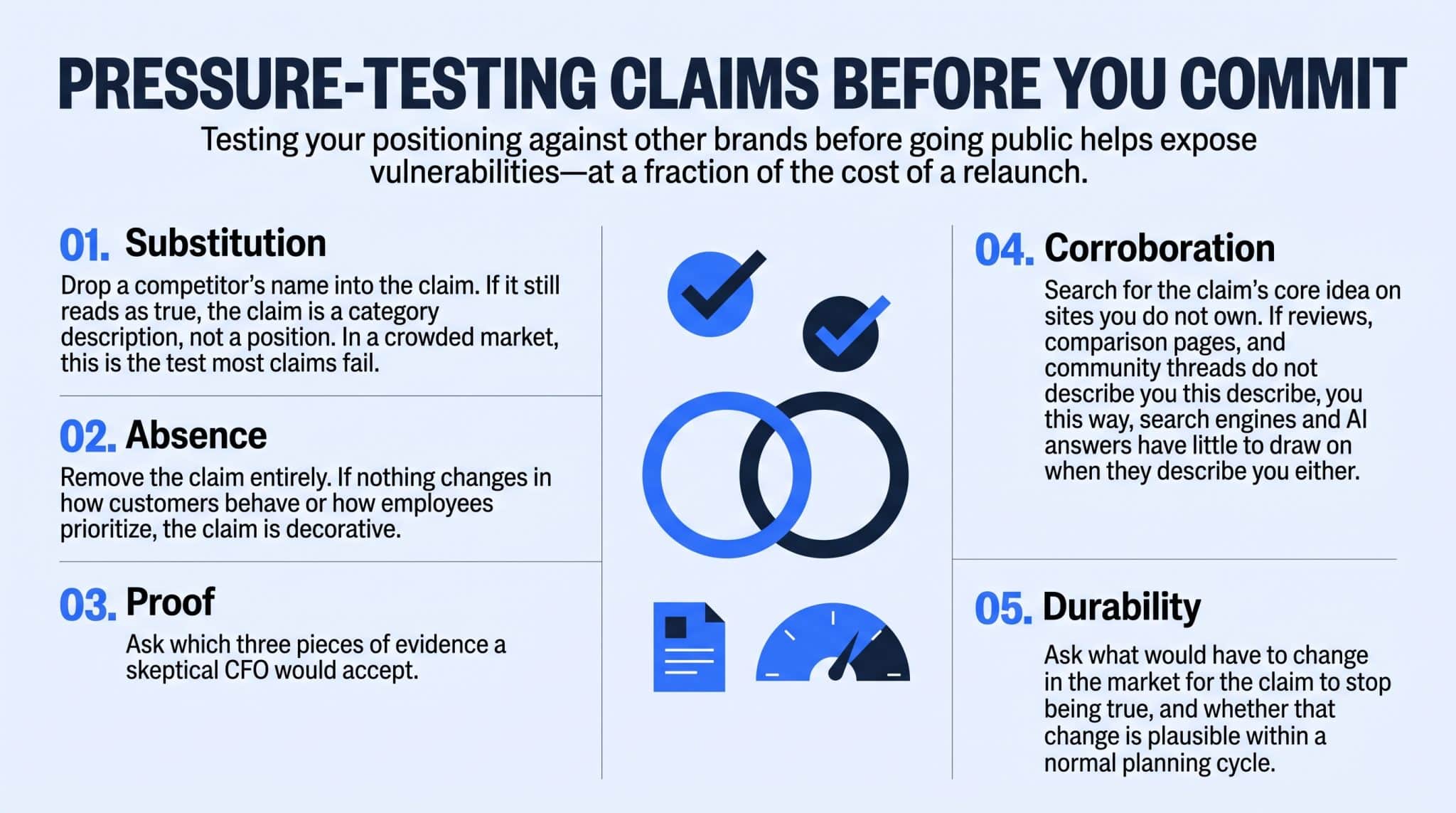
Reviewing how other brands in your category have positioned themselves helps to surface risks and opportunities for your own. Testing using this comparison is far cheaper than a relaunch, and it tends to expose the same vulnerabilities.
Five tests are worth running before the claim goes public:
-
Substitution: drop a competitor's name into the claim. If it still reads as true, the claim is a category description, not a position. In a crowded market, this is the test most claims fail.
-
Absence: remove the claim entirely. If nothing changes in how customers behave or how employees prioritize, the claim is decorative.
-
Proof: ask which three pieces of evidence a skeptical CFO would accept.
-
Corroboration: search for the claim's core idea on sites you do not own. If reviews, comparison pages, and community threads do not describe you this way, search engines and AI answers have little to draw on when they describe you either.
-
Durability: ask what would have to change in the market for the claim to stop being true, and whether that change is plausible within a normal planning cycle.
What to do when the evidence contradicts the brand strategy
Research often returns a version of the business leadership does not agree with. The instinct is to perform the study again. A more productive response is to separate what the company believes it delivers from what buyers say they experience. The gap is problem with the brand strategy. This is a finding on its own.
Some contradictions resolve quickly. For example, a product feature that internal teams treat as central may be invisible to buyers. Other contradictions reveal a delivery issue that no amount of messaging will fix. Those belong on an operational list rather than in a positioning document. The same applies to what third parties say. If reviews and community threads consistently describe a weakness, a new claim will not talk buyers out of what they have already read.
If the evidence raises a factual question, you cannot settle internally. You must confirm it against a primary or official source before it becomes part of the claim.
Positioning research as part of a brand audit
The Brand Auditors structures its brand audits across six areas:
Positioning research draws on all six, which is why it tends to produce a different answer than a standalone messaging review.
A brand analysis also covers visibility across search, content and social channels, where the off-site evidence described above shows up.
The financial lens is the easiest one to skip. But a claim that cannot be connected to revenue, retention, or acquisition cost is hard to defend internally, regardless of how well the research supports it.
Run your current claim through the five tests above before your next campaign. If it can't pass the test, talk to us about how to get the research that can carry it.

POST AUTHOR
Ready to take the next step?
You have the information. Now let's turn it into a plan that works for you.
Enjoyed this article? Here's what to read next.

Custom Business Intelligence and Consulting Services
Boost your business’s decision-making power with business intelligence and consulting. Learn how BI consulting can transform data into actionable insights.

The Business Guide to Marketing Analytics Consulting
Want to improve your marketing strategy? Marketing analytics consulting services provide data-driven insights and recommendations to optimize your campaigns.

Strategic Business Growth Consulting Services: Scale, Optimize, and Overcome Obstacles
We help mid-market and global enterprises scale operations, enter new markets, and achieve sustainable growth. Unbiased, data-driven strategy. Schedule your session.